



Numerous studies find that less than 30% of organizations achieve their desired strategic outcomes. The failures are rarely the result of the strategic planning process. Rather, poor communication, lack of accountability, insufficient resource allocation, and the structure and culture of the organization are the main culprits. These lead to misalignment, and an inability to achieve strategic priorities.

Organizational alignment is the connection between strategy, goals, and the daily work of employees. It brings together structure, processes, resources, and expectations so that the work of individuals and teams matches where the organization is trying to go. Alignment is critical for effectiveness, productivity, and financial success, ensuring leaders and their teams maintain a focus on executing the work that supports achievement of strategic priorities.
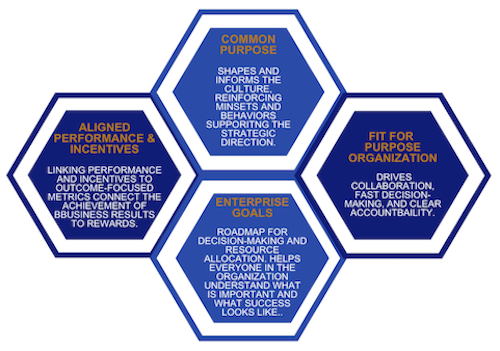
Successful strategy execution requires four elements:
-
A Common Purpose — An organization’s purpose, supported by a clear vision, mission, and shared values, guides strategic choices and priorities. It is a North Star providing direction, and a common language and understanding about what is most important. This helps leaders and teams navigate challenges by providing a shortcut for decision-making when trade-offs arise, making it easier for everyone to move in the same direction.
Purpose fosters higher levels of employee engagement where there is alignment with an employee’s personal values. When work feels meaningful, employees are more likely to be highly engaged and productive, putting in more discretionary effort which directly supports the execution of strategic goals.
It also shapes and informs the culture – the shared values, norms and behaviors that determine how people behave when leaders are not present. Culture can be a driver, or derailer, of strategy execution. A culture that aligns with the organization’s goals will include mindsets and behaviors that support the strategic direction, increasing the likelihood of successful execution. By contrast a misaligned culture creates resistance to change and results in failed execution, regardless of how well or carefully the strategy and goals were crafted. -
A Fit for Purpose Organization — The design of an organization impacts its ability to achieve its strategic goals, meet customer expectations, and maintain market competitiveness. When organizations align their purpose and operating model, the resulting structures, roles, and ways of working establish the right conditions for collaboration, fast decision-making, and accountability. Strategy informs structure, and structure enables execution.
Being fit for purpose enables execution by translating the strategy into reality. It ensures that all elements – structure, processes, resource allocation, and decision-making – align with the organization’s strategy. Execution is further enabled by increased employee performance and productivity. Organizations with a high level of alignment have less friction and redundancy due to increased clarity around priorities and accountability.
A good organizational design bridges strategy with execution, creating efficient and flexible structures that can adapt to changing market conditions. Doing this takes time and commitment. It is an iterative process requiring ongoing adjustments as the operating environment shifts. The payoff is better operational efficiency and financial performance as the strategic goals are achieved.Organizational alignment is the connection between strategy, goals and the daily work of employees bringing together structure, processes, resources, and expectations so that the work of individuals and teams matches where the organization is trying to go.
-
Enterprise Goals — Common enterprise strategic goals create alignment and provide direction. Through defining clear, measurable, and time-bound priorities, organizations can improve performance, reduce costs, and drive growth. Effective enterprise goal setting involves:
- Identifying priorities and desired outcomes based on the organization’s purpose and current business opportunities or challenges.
- Establishing SMART (Specific, Measurable, Achievable, Relevant, and Time-bound) Goals that support the priorities and desired outcomes.
- Defining metrics for each goal, selecting measures that can clearly show progress and impact.
- Assigning leadership team members to own the enterprise goals, with accountability for follow-through and tracking progress.
- Cascading goals throughout the organization, with each business unit or department creating goals based on the enterprise goals.
Common goals help the organization to focus on priorities by providing a roadmap for decision-making and resource allocation. When done well, goal setting ensures that everyone in the organization understands expectations, what is important, and what success looks like. The process also fosters accountability through tracking and measuring results over the course of the year and connecting the results to performance management and rewards. -
Aligned Performance Process & Incentives — Practices such as using a common performance management approach and linking incentives to outcome-focused metrics, connect achievement of business results to performance and rewards. This is essential to effectively executing strategic goals. What gets measured (and rewarded) will get done, and having misaligned rewards may incentivize poor behavior or a focus on low-value activities that detract from an organization’s priorities.
When performance and incentives link to strategic goals, leaders and teams understand performance expectations and what they are accountable for delivering. Another advantage of this linkage is the motivation and retention of high-performing employes, and the ability to quickly identify and manage poor performers. Metrics and rewards reinforce what is valued, and are integrated through KPIs, rewards, recognition, and performance management processes and practices.

Highly aligned organizations synchronize their strategy, purpose, structure, goals, processes, and incentives to execute for results.
Ready to hear more? Contact our sales team today.