




Project Management Perspectives — Part 3 of 5
The period from 2022 through early 2026 has been characterized by the rapid maturation of AI from a background analytics capability to an active, visible participant in program and project management workflows. The public release of ChatGPT in November 2022 served as the catalyst that accelerated awareness, experimentation, and — importantly — investment. But the most significant advances in P&PM have come from the convergence of multiple AI disciplines: machine learning for predictive analytics, natural language processing for documentation and communication, and early generative AI for planning and reporting acceleration.
Predictive Analytics: From Reactive to Anticipatory
Perhaps the most substantively transformative AI capability to penetrate IT program management during this period has been predictive analytics. Traditional project management is inherently reactive: status reports reflect what has happened; issue logs capture what has already gone wrong; risk registers identify threats that may or may not materialize. AI-driven predictive analytics fundamentally inverts this model.
Machine learning models trained on historical project data — schedule performance, budget variance, resource utilization, defect rates, stakeholder engagement patterns — can now identify with statistically significant accuracy which current projects are likely to experience schedule slippage, cost overrun, or scope expansion, often weeks or months before those problems become visible in traditional reporting. Research has demonstrated that gradient boosting machine models achieve up to 85% accuracy in risk identification from project data, substantially outperforming human judgment applied to the same data sets.
In the context of IT initiatives — where the complexity of system interdependencies, vendor relationships, and technical dependencies creates a dense web of potential failure modes — this predictive capability is transformative. A Program Manager equipped with AI-driven predictive insights can shift from managing problems to preventing them, redirecting executive attention from crisis response to proactive course correction.
54% of project managers surveyed in 2024 reported using AI for project risk management, while 52% were using AI for predictive analysis and forecasting — making risk and forecasting the two most rapidly adopted AI use cases in P&PM (Capterra, 2024).
Generative AI: Rewriting the Administrative Load
The introduction of large language model capabilities into project management workflows has addressed one of the profession's most persistent and least strategic burdens: the documentation, reporting, and communication overhead that consumes a disproportionate share of experienced Program Managers' time.
In IT program environments, this overhead is substantial. Weekly status reports, steering committee presentations, risk register updates, meeting summaries, change request documentation, stakeholder communications, and lessons-learned reports collectively represent dozens of hours per program per week — hours spent by senior professionals on assembly and formatting rather than analysis and judgment. Generative AI tools, deployed thoughtfully and with appropriate human review, have demonstrated the ability to reduce this documentation burden by 40–60%, returning significant capacity to higher-value program management activities.
PMI's own research on Generative AI and project management confirms the trend: GenAI is demonstrably boosting productivity and enhancing key performance metrics for project professionals who have adopted it. Critically, the research also highlights an adoption gap — approximately 80% of project professionals either have limited experience with AI tools or have not yet adopted them meaningfully, creating a significant and widening performance differential between early adopters and the broader profession.
The project managers who are adopting AI today are not working harder. They are working on fundamentally different and more valuable work — freed from the documentation burden to focus on the judgment, stakeholder intelligence, and strategic thinking that AI cannot replicate.

AI-Assisted Resource and Schedule Optimization
Resource management — determining which people, with which skills, should be allocated to which programs and workstreams, at what times, across a portfolio of competing initiatives — is one of the most complex optimization problems in enterprise project management. Human Program and Portfolio Managers, working from spreadsheets and tribal knowledge, consistently make resource decisions that are suboptimal: over-allocating high performers, under-utilizing available capacity, and creating bottlenecks that cascade across interdependent programs.
AI-driven resource optimization engines, drawing on historical performance data, current workload data, skills profiles, and project requirements, now provide significantly more accurate and dynamic resource recommendations than human planners working alone. Similarly, AI-driven schedule optimization — adjusting task sequences, critical path configurations, and contingency buffers in real time as project conditions evolve — delivers measurably better schedule outcomes than static, human-maintained project schedules.
Research across IT project environments consistently demonstrates that AI-assisted resource and schedule optimization delivers 15–40% improvements in efficiency and 20–30% reductions in unplanned cost — meaningful returns on relatively modest AI investment.
The Adoption Reality: Promise and Gap
Against this backdrop of genuine capability and documented benefit, the current state of AI adoption in P&PM is best characterized as uneven and, in many organizations, dramatically under-exploited. The Capterra 2025 Project Management Software Trends Survey found that 55% of organizations cited AI as the top trigger for their most recent project management tool purchase — yet 41% of those same organizations reported that AI adoption remains a significant challenge, 39% cited a lack of AI skills on staff, and 36% identified integration with existing workflows as a major hurdle.
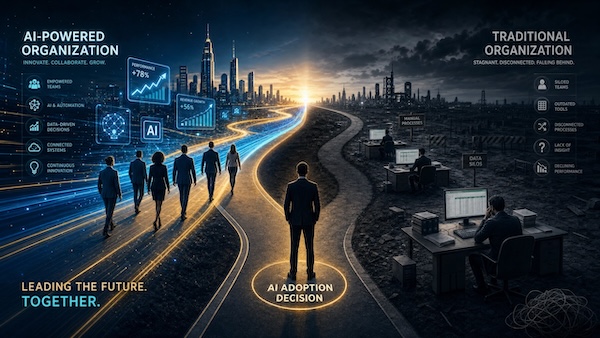
This adoption gap is not a technology problem. The tools exist, and their value is demonstrable. It is a leadership, culture, and organizational readiness problem — precisely the domain where strategic advisors and senior Program Management leaders add the most value. Organizations that create the conditions for AI adoption — investing in data quality, building AI literacy across their project teams, and embedding AI tools into their governance and delivery frameworks — are pulling decisively ahead of those that purchase AI tools without providing the organizational foundation for their effective use.
Only 20% of project managers report having extensive or good practical experience with AI tools, while 49% have little to no experience (PMI, 2025). This is the single most consequential skills gap in the project management profession today.
Don't miss our next installment:
How AI Is Transforming Project Management - Part 4—The Intelligent Project Management Office
Ready to hear more? Contact our sales team today.