



Readiness isn't a technology question. It's a sequence of strategic decisions that have to happen first.
Start With the Job, Not the Journey
AI readiness for brand and experience starts with a question most companies haven't answered: what job are customers actually hiring you to do ? Not the product they're buying — the progress they're trying to make. Until leadership can answer that with specificity, every AI decision will optimize for the wrong thing. Speed, volume, deflection rates — none of these are the customer job.
This isn't a semantic distinction. It has direct consequences for every automation decision a company makes. A regional healthcare provider that defines its customer job as ‘get helpful medical services' will make very different AI decisions than one that defines it as ‘help me to feel confident that I’ve explained my issue well so that I get the right care at the right time from the right medical professional.' The first optimizes for throughput. The second asks whether each touchpoint — including the automated ones — is building or eroding the customer's confidence. Same technology, completely different deployment logic.
Getting to this level of clarity requires talking to customers in a structured way — not a satisfaction survey, but genuine conversations about what they were trying to accomplish when they chose you, what finally pushed them to make a change, and what they would need to see to stay. Five to ten of these conversations, conducted with real curiosity, will surface the job with more precision than years of internal debate. The investment is small. The clarity it produces shapes every AI decision that follows.
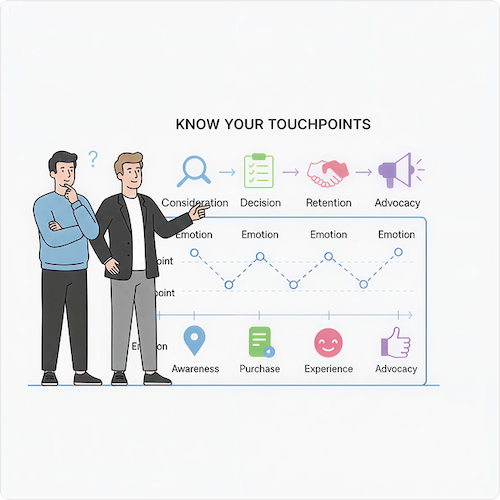
Map the Journey, Protect What Matters
From that foundation, map the customer journey honestly and identify the moments that carry the most relational weight — where trust is built, tested, and either reinforced or spent. These moments need explicit protection before any automation decision is made, because they are where your competitive position actually lives.
Honest is the operative word here. Journey mapping done well isn't a diagram of how the experience is supposed to work — it's a clear-eyed account of what actually happens, including the friction, the gaps, and the moments where the brand's promise and the customer's experience diverge. Most companies that have done this work are surprised by where the highest-stakes moments actually are. They're often not where the team assumed. And the moments that were assumed to be high-stakes are sometimes far less load-bearing than expected.
What makes this exercise specifically useful for AI readiness is that it produces a map with explicit ownership. Not just 'here are our touchpoints' but 'here are the moments that are structurally connected to what makes us worth choosing — and these are the ones that will not be handed to an automated system until we can demonstrate that the system genuinely serves the customer's job better than a human would.'
AI is an amplifier. It will make you faster and more consistent and whatever you’re already doing. If what you’re doing is serving the customer’s real job, AI accelerates your advantage. If what you’re doing is serving your operational metrics , AI accelerates your drift away from the advantage customers choose you for.
Pick the Moments You're Competing to Own
It’s crucial that you decide which moments you are competing to own — where good enough is the wrong standard and being meaningfully better than any alternative is the only acceptable outcome. For those moments, AI belongs only if it genuinely improves the experience. Everything else can be optimized. These moments cannot, and most like should not.

The decision of where to compete is one that most companies skip even when they've done serious journey work. They identify the high-stakes moments but they don't take the next step — deciding explicitly which moments they are going to invest in being best at, and building a competitive moat around. That's a very different commitment than optimization. It means looking honestly at where in the customer journey you can deliver something that a competitor would struggle to replicate, and then designing every touchpoint connected to that moment to support and reinforce that core.
Consider how Meta built confidence among brand advertisers. Its core value proposition — helping brands reach new customers — isn't proven by a brand running its first ad campaign. It's proven by the consumer experience first: people encountering ads for products that tell great visual stories, experiencing firsthand that the platform works for discovery. The consumer experience is the connected moment that makes the advertiser experience credible. One depends entirely on the other. Companies that understand this kind of structural dependency make very different AI decisions than companies that evaluate touchpoints in isolation.

The Sequence Is the Strategy
These three steps — knowing the job, mapping the journey honestly, and deciding which moments to own — form the complete pre-work for any AI initiative in brand and experience. They can be worked through in a few focused leadership conversations, so the time investment is modest . However, the clarity that is produced is the difference between AI that compounds a brand's competitive advantage and AI that gradually hollows it out. The successful adoption of AI doesn’t start with the technology, it starts with strategic leadership.
Ready to hear more? Contact our sales team today.